

Most creators who lose their income lose it in the payment layer.
A payment processor closes the account. An ad network pulls monetization. A bank flags the deposits. The videos stay up, the audience is still there, and the money stops moving.
Between a fan who wants to support a creator and the creator who earns that support sits a chain of intermediaries: processors, ad networks, banks, payout providers. Each one has its own policies. Each one can say no. The creator never signed those policies, cannot audit them, and usually cannot appeal them. Their income depends on rails they do not control.
None of this depends on what any particular creator says. The mechanic is the same for a cooking channel and a news commentator. If your income passes through an intermediary, the intermediary decides whether you get paid. Most creators discover this only when the answer changes.
What Rumble Built
Rumble Wallet takes the intermediary out of the tip.
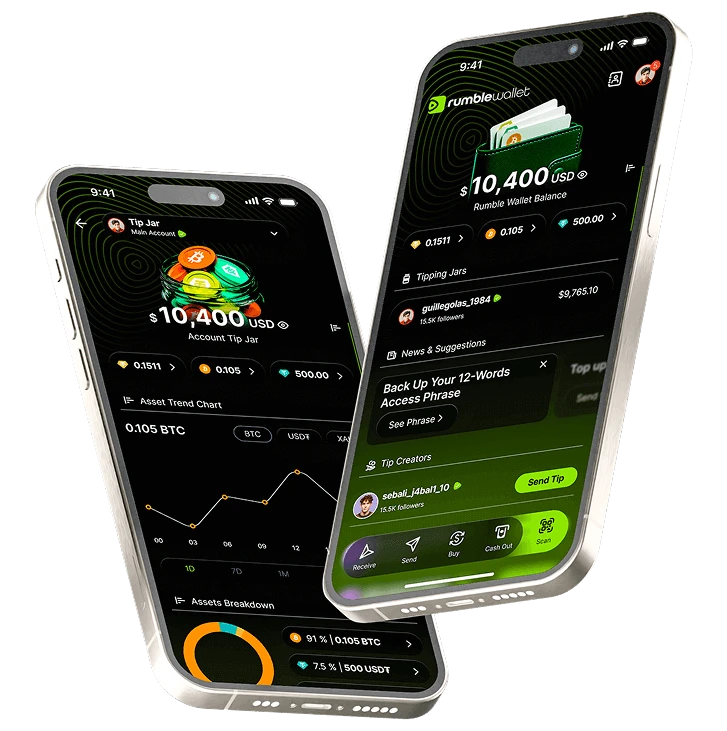
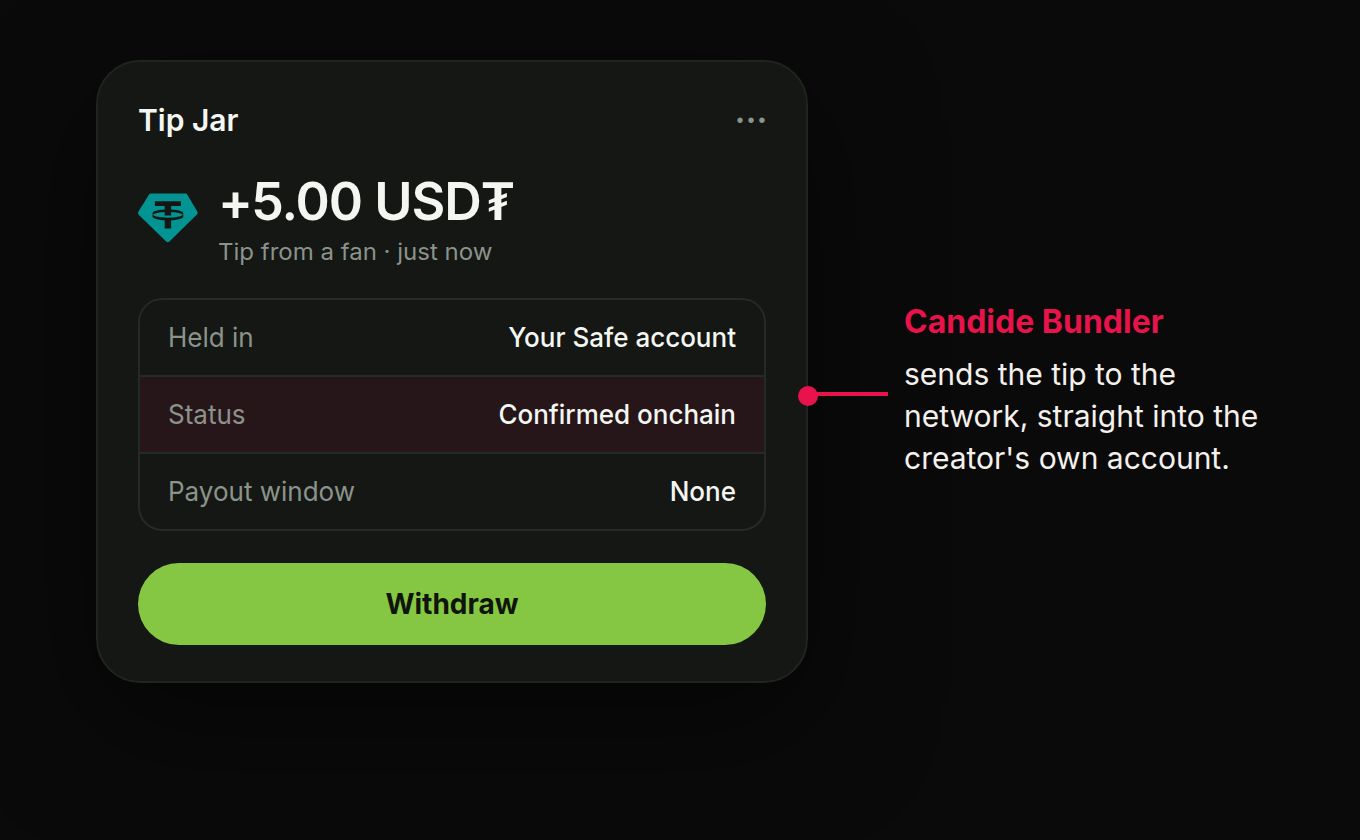
Fans tip creators directly in USD₮, XAU₮, or USA₮. The tip moves onchain from the fan’s account to the creator’s account. Earnings land in a self-custodial Safe smart account. The keys stay on the creator’s device. There is no custody at the wallet layer.
Creators hold their earnings and move them when they choose. There is no payout window because there is no payout provider.
Self-Custody for People Who Have Never Heard of Gas
Rumble’s audience is mainstream. A fan sending a $5 tip holds no ETH and has no intention of acquiring any. Asking them to buy a volatile token on an exchange before they can support a creator ends the transaction before it starts.
Rumble Wallet handles this at the infrastructure level. Gas is paid in the asset being sent. Tip in USD₮, and the fee comes out in USD₮. Tip in XAU₮, and the tokenized gold pays for its own movement. The fan sees a tip, an amount, and a confirmation.
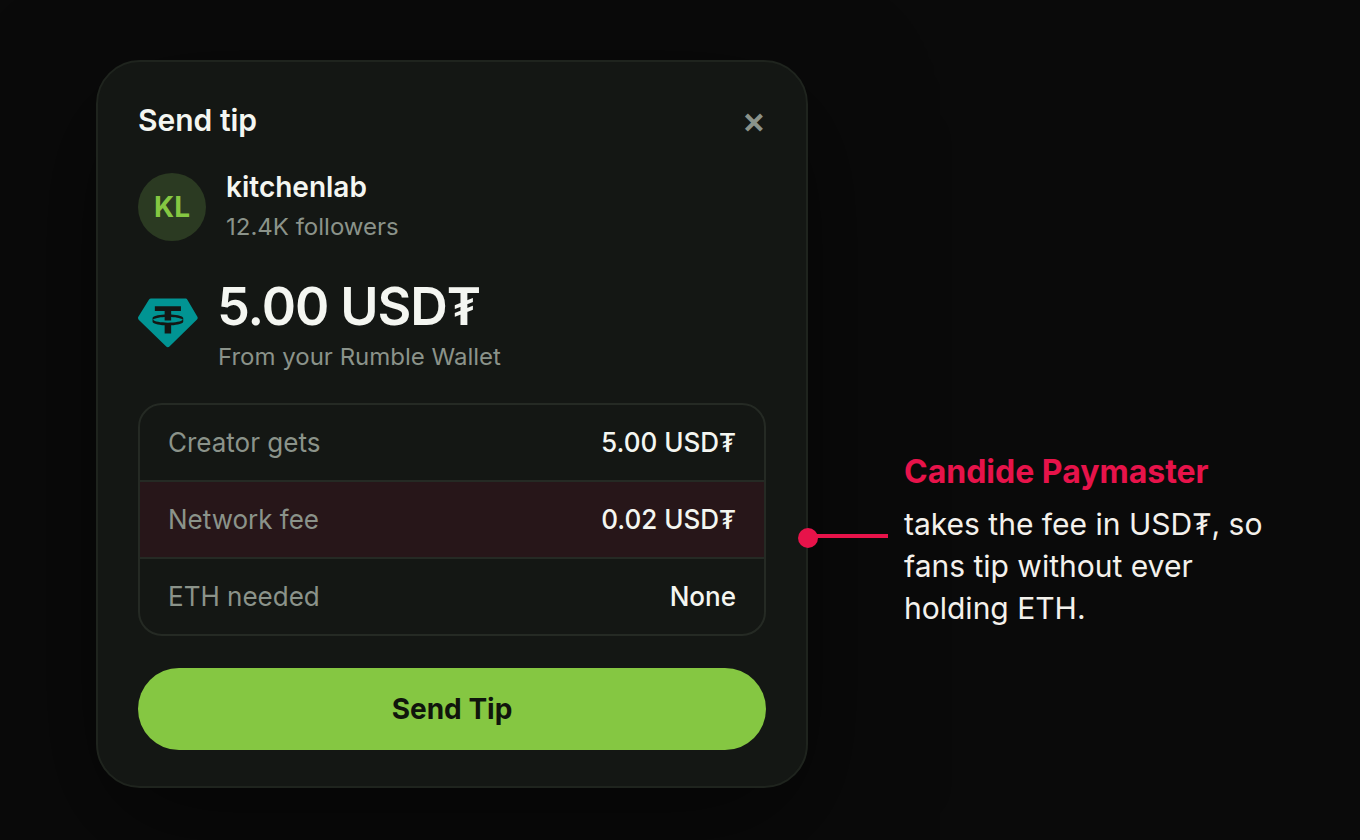
For crypto-native products, gas abstraction is a quality of life improvement. For a consumer product with a mainstream audience, it decides whether the product works at all. Self-custody only reaches that audience if the audience never has to think about the machinery underneath it.
The Infrastructure Layer
Candide operates the bundler and paymaster inside Rumble Wallet, across Ethereum mainnet, Arbitrum, Polygon and Plasma.
The bundler processes ERC-4337 UserOperations, the standard transaction format for smart accounts. The paymaster accepts USD₮, XAU₮, and USA₮ for gas. Rumble built on Tether’s WDK, the open-source wallet toolkit built on Safe smart accounts, the same stack behind tether.wallet. Every layer is an open standard.
That matters for the same reason the rest of the architecture does. Rumble is not locked into Candide. Any compliant bundler can process the same transactions, and the paymaster can be replaced without a migration. The self-custody promise holds because no layer of the stack holds keys. Candide processes transactions. It does not hold funds or keys, and it is replaceable. If Candide stopped, another bundler would process the same operations.
Rumble Wallet also supports Bitcoin through a separate stack.
Infrastructure does not have opinions about who uses it. That is what makes it infrastructure. The rails that move a creator’s income should work the way roads and DNS work: for everyone, by design, with no one positioned to decide otherwise.
Rumble made that the foundation of its monetization layer. Candide’s job is to keep it running.