

Adaeze teaches at a secondary school in Surulere. On the last Friday of every month since March 2021 she has moved ₦100,000 out of her current account and into her savings account, and because the bank charges her nothing to do it and pays her a little to leave it there, she has never seriously considered doing anything else with the money. Sixty-six transfers. No missed months. Nothing withdrawn.
She has ₦6,600,000.
At this week’s market rate, that is about $4,800. Had she changed each ₦100,000 into dollars on the Friday she saved it and held the dollars, she would have about $6,894. Had she bought gold with it, about $14,337.
She did not make a mistake. The deposits landed, the interest accrued, the statements arrived, and the naira went from around ₦485 to the dollar in March 2021 to ₦1,371 this week. Everything she was told to do, she did. The unit she was told to do it in moved.
Savers in Lagos worked this out a long time ago, which is why so much of the country’s household wealth sits in physical dollars in a drawer, or in gold, or in a domiciliary account whose withdrawal limits are set by someone else. None of those are good. Cash gets stolen and earns nothing. Gold is hard to buy in small amounts and harder to sell in a hurry. Domiciliary accounts are a bank’s promise, and Nigerian savers have watched those promises get rewritten. What people want is dull and has been difficult to obtain: somewhere to put money every month that does not lose a third of its value while it sits there.
What Enta Built
Enta is one account holding USD₮, tokenized gold, and Bitcoin, funded from a Nigerian, Ghanaian, or Kenyan bank account. Bitcoin runs on a separate stack; the dollars and gold run on the infrastructure described below. Money arrives in naira and lands in whichever of the three the saver picked. Moving between them happens inside the account.
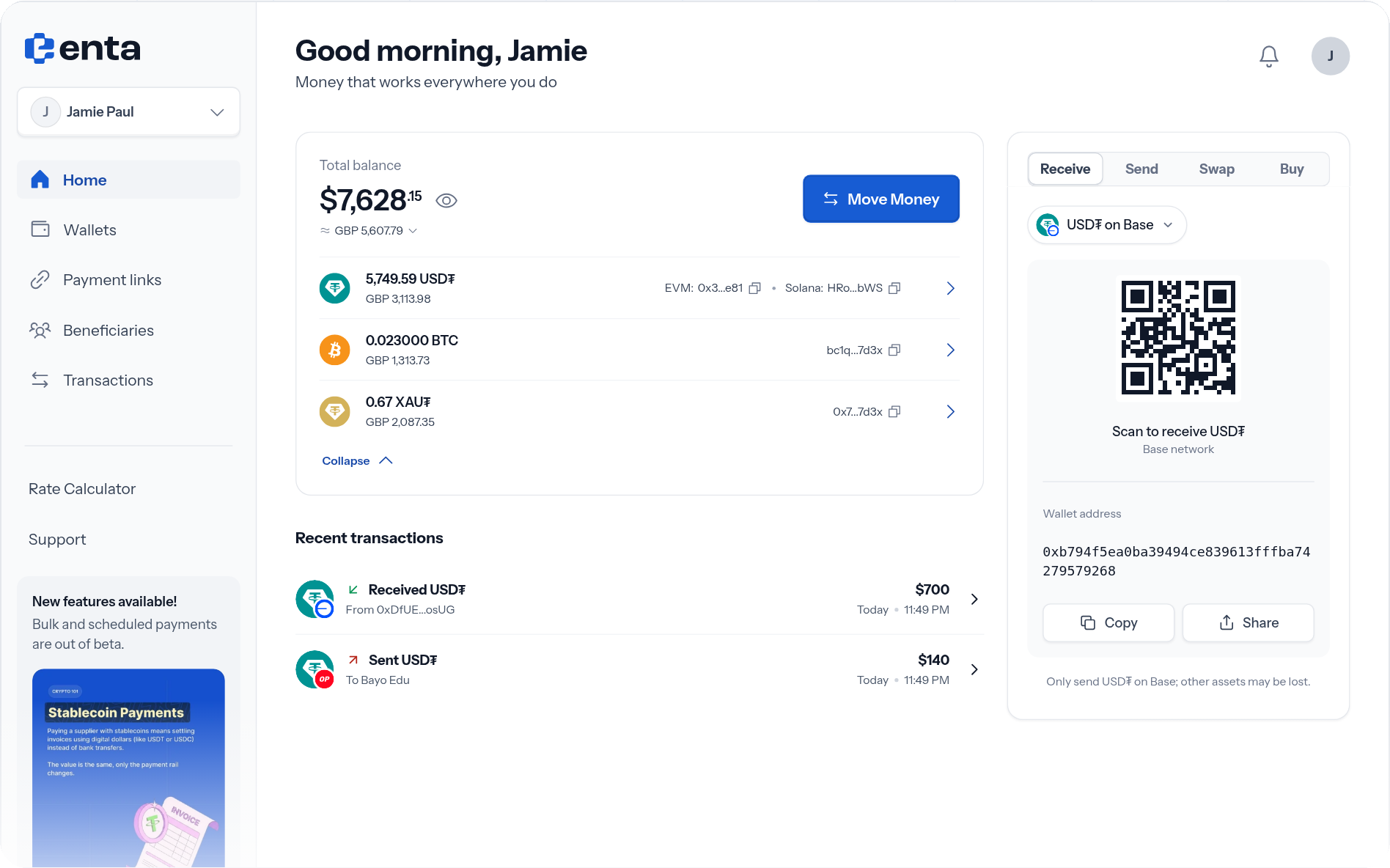
Businesses use the same product, and for them the clock runs faster. A freight forwarder invoicing in four currencies is not worried about 2021. The worry is the gap between raising an invoice and being paid, because the rate moves inside that window and the correspondent bank takes a cut nobody itemises. Enta settles on Shiga’s own rails, so the quoted rate is the rate.
“We have been building financial infrastructure in this market for years, and in that time I have watched a great many products get built the quick way. There are very few accounts put together the way Enta is, and the reason is that our way costs more and takes longer. We took that on deliberately. We would like Enta to be what people point to when they describe what an onchain account ought to be.”
Abiola Shogbeni, Founder & CEO, Shiga Digital
The Cheaper Way to Build This
There was an obvious way to build Enta, and Shiga did not take it.
The obvious way is to hold everything. The company opens accounts at a few venues, buys the dollars and the gold and the Bitcoin in its own name, runs a database of who is owed what, and shows each customer a balance. This is how most of the products in this category work. It is faster to ship, cheaper to run, easier to reconcile, and it makes the multichain problem disappear entirely, because there are no chains involved from the customer’s side. Nothing moves onchain until somebody withdraws.
The cost of that design is that the balance on the screen is a number the company maintains. It is accurate as long as the company is solvent and not subject to an order compelling it to do something else. Nigerian savers have a long and specific education in what happens when an institution’s records and a customer’s money turn out to be different things.
Shiga built the harder version. Each Enta account is a Safe smart account, and the assets sit in it.
That decision created a new problem. Dollars and gold do not live in the same place. They live on different chains, and until recently an account meant an account on one chain. A product offering these assets across several chains either accepted that its customer had several accounts and several signatures and several sets of fees, or it went back to holding everything.
One Account, Several Chains
Candide’s Safe Unified Account is what let Shiga refuse that choice.
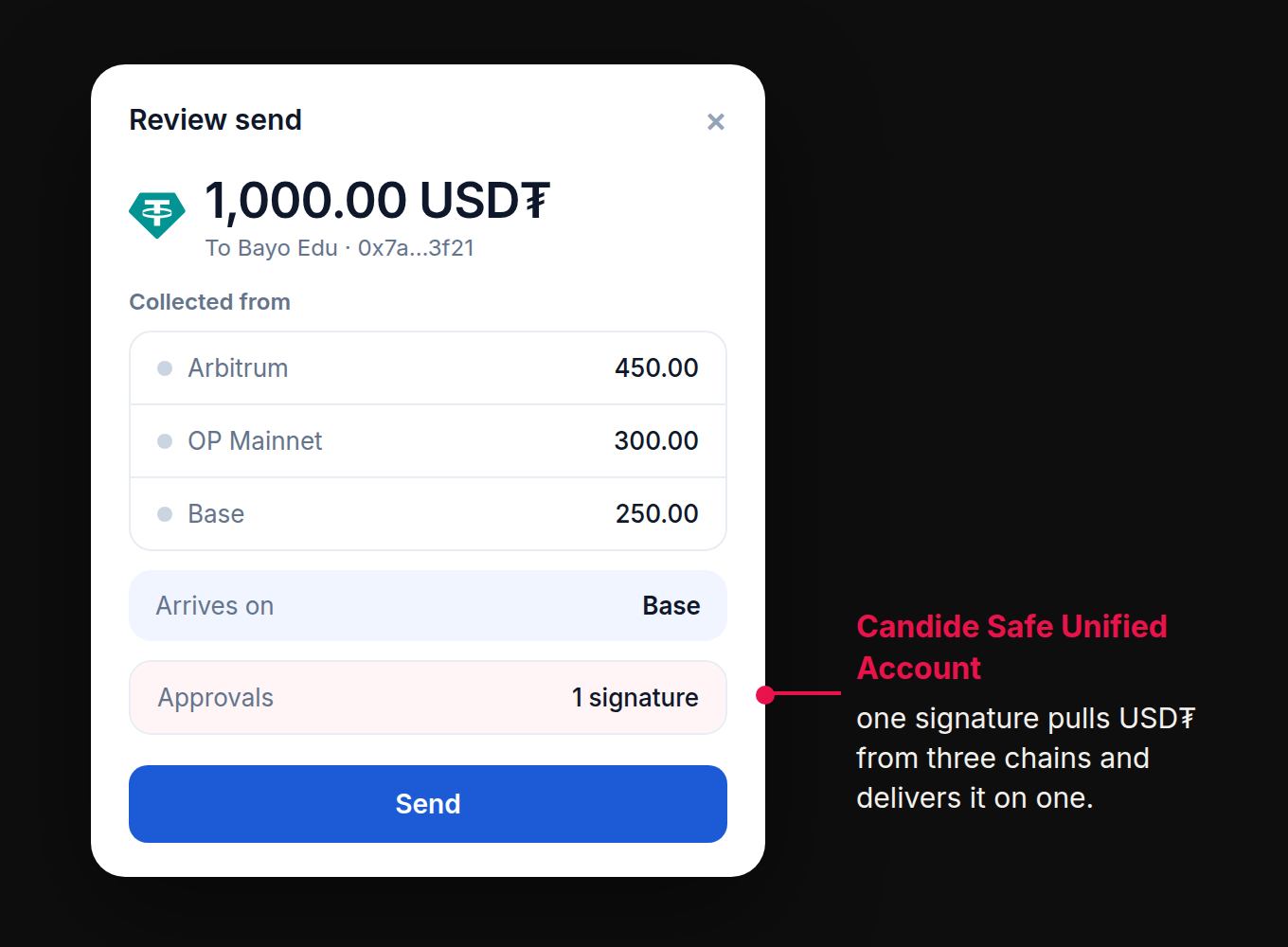
The account exists at the same address across every chain it operates on, and a single signature authorizes what happens on all of them. It works by signing a Merkle root that commits to a set of operations, one per chain, so a saver approving a move approves the whole thing once and no relayer is trusted to carry her intent from one chain to the next. She sees an account. Underneath, it is several, and they agree because she signed the root that binds them.
A saver with dollars spread across three chains sends them to one recipient, on one chain, with one approval.
Fees Come Out of What You Hold
Enta’s customers hold dollars and gold. They do not hold ETH.
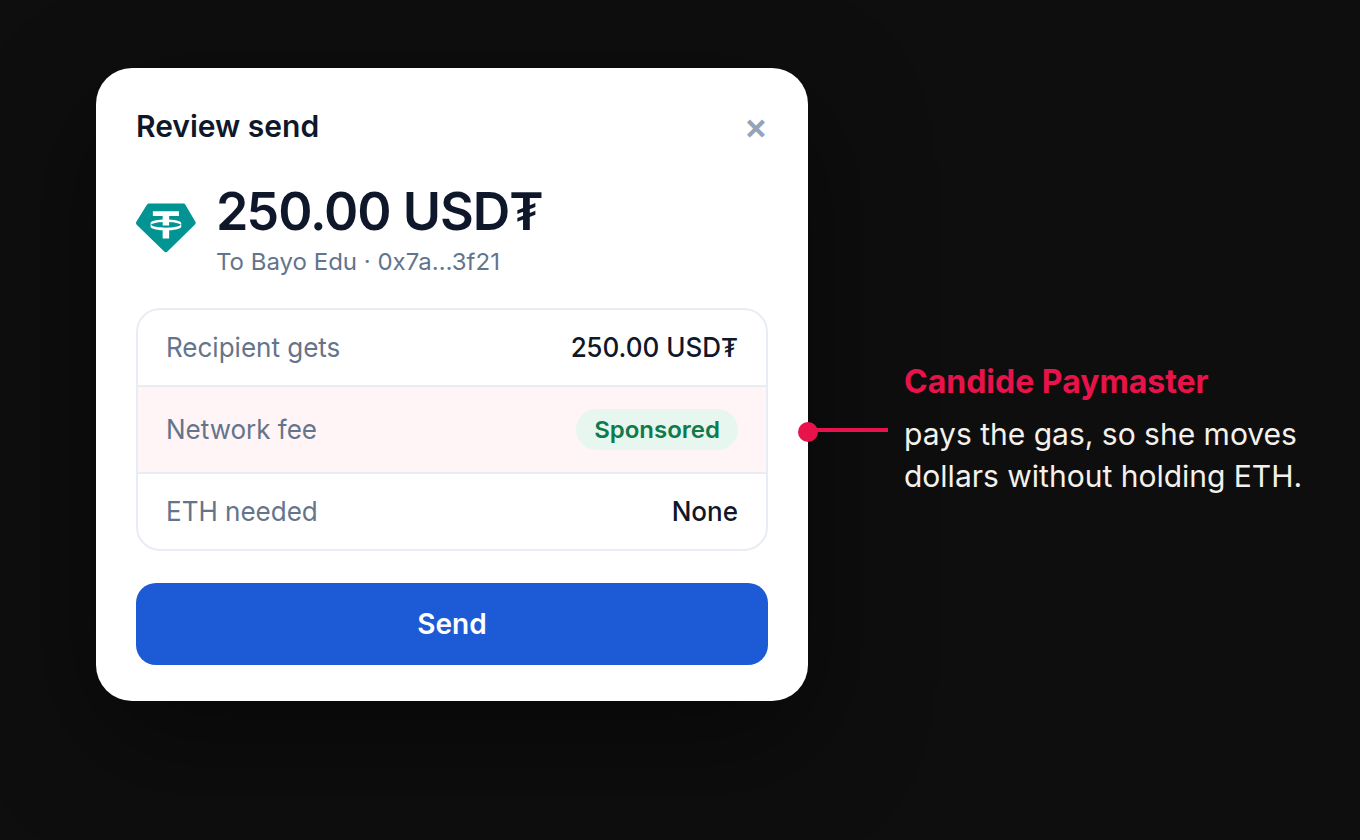
The usual framing is that gas abstraction spares users an annoying step. Here it is closer to the point of the product. A teacher moving money out of a currency that cost her two thousand dollars is not going to be told that the first step is to buy a different volatile asset on an exchange in order to be permitted to move her own money. She would close the app, and she would be right to.
So the fee comes out of the asset being moved. Send USD₮ and the fee is USD₮. Move gold and the gold pays for its own movement. Some flows are sponsored outright and she sees a transfer and an amount.
The Infrastructure Layer
Candide runs three things inside Enta. The bundler processes ERC-4337 UserOperations, which is the standard transaction format for smart accounts. The paymaster takes the asset the customer already holds as payment for fees, or sponsors them. Safe Unified Account supplies the account model that spans chains.
All of it is open standard, which matters mainly for what it lets Shiga do if this relationship stops working. Any compliant bundler processes the same UserOperations. The paymaster can be swapped without migrating a single account. Candide processes transactions and does not hold keys. Leaving would be cheap. The arrangement continues because it works.
The local-currency legs run through licensed transmitters in each market, which makes those legs regulated and intermediated in the ordinary way; the part of Enta that is not a bank is the part that holds the assets, not the part that moves the fiat. And the three assets carry three different risks. Gold is not a dollar and Bitcoin is not gold, which is why Enta lets the saver choose instead of choosing for her.
Enta’s bet is that the teacher in Surulere will not take much persuading. The arithmetic is already hers. What she has never had is somewhere better to send the sixty-seventh deposit.
Adaeze is a composite, not a named Enta customer. The dollar and gold figures are Enta’s published savings calculator output for sixty-six monthly deposits of ₦100,000 beginning March 2021; the $4,800 is her naira at this week’s market rate.
Enta: entashiga.io
For teams building something similar: docs.candide.dev